2026-08
The drawing numbers its panels twice and skips four
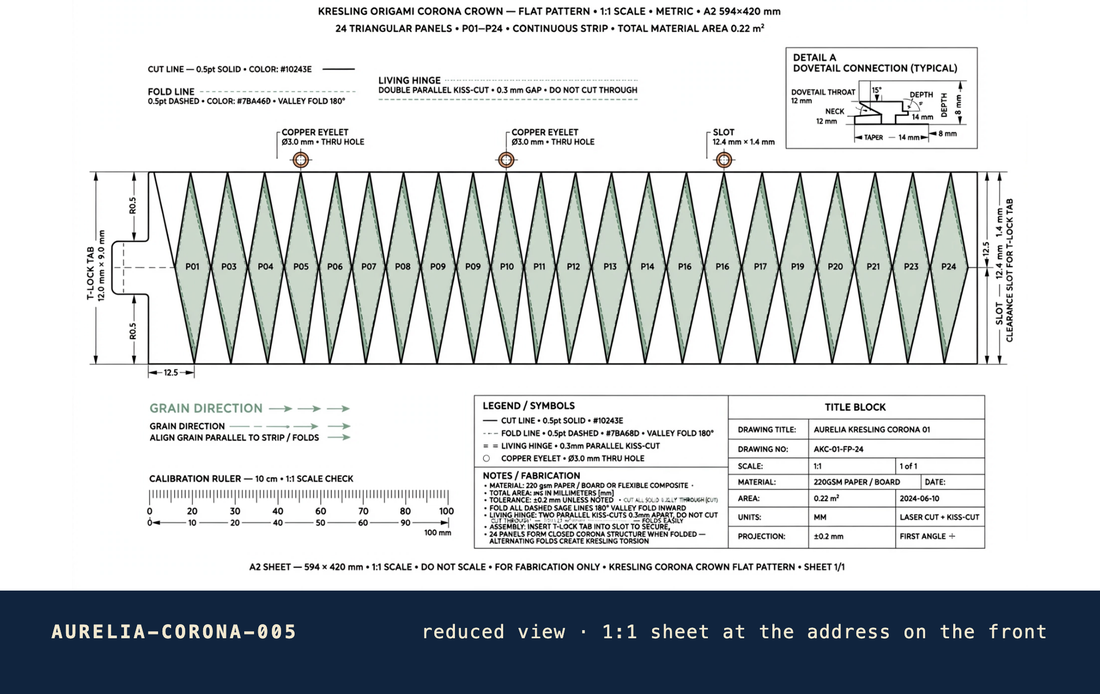
Four panel numbers are missing from the flat pattern and two numbers are used twice. The shape itself is right, so count panels as you cut instead of trusting a label.
CARD 005
Twenty-four-panel folding crown
A crown you fold from one flat sheet. Twenty-four triangles in a single strip, twisted into a short tower and worn on the head. It packs flat and springs open. Nobody has made one — this is a drawing, and every number here came off it.
Schematic, not the cutting file. About 190 mm across and 95 mm tall — twice as wide as it is high, which is why the drawing is too. The three copper marks are the shim tips, on the panels nearest you.
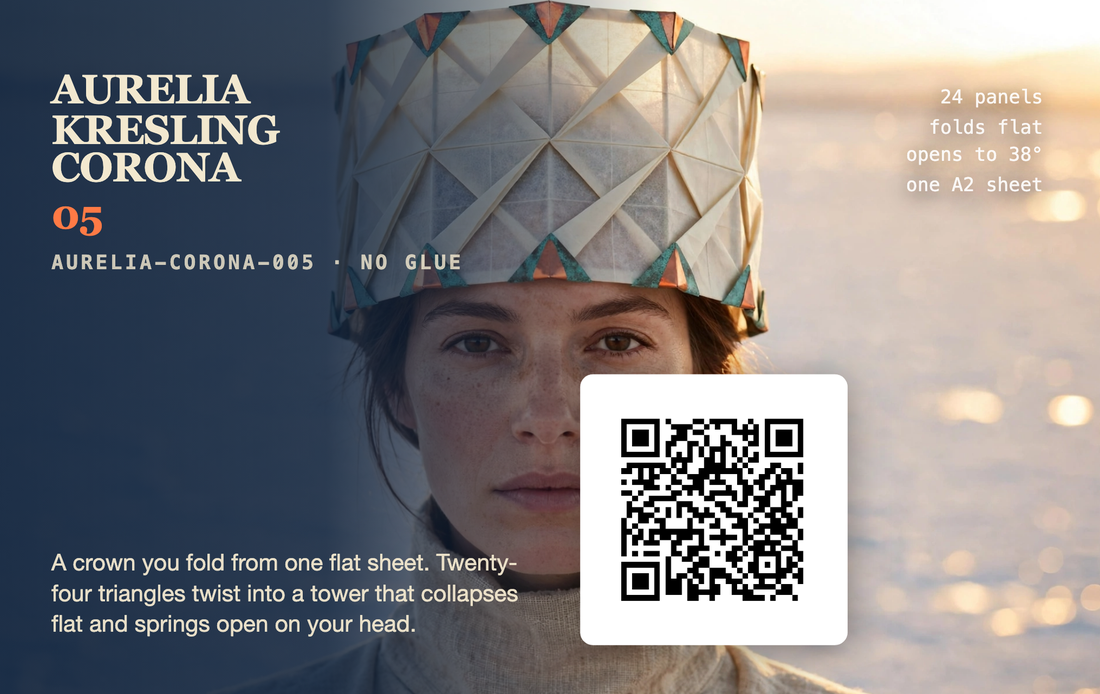
The face on the front is a generated render. Nobody was photographed and no such person exists. The other cards in this book show no face at all, so this one is the exception and it is said out loud rather than left for you to guess.
A crown. One long strip of twenty-four triangles, cut from a single flat sheet, folded along its own lines and rolled into a short tube that sits on your head. It is about 190 mm across and 95 mm tall. Nothing is glued and there are no screws — a tab pushes into a slot and holds.
It packs flat. Press it and it collapses into a ring you could put in a bag; let it go and it stands back up. There is a slit at the back that adjusts from 14 to 19 cm, which is how one crown fits different heads.
The card calls it an Aurelia Kresling Corona, which is three hard words for a folded paper crown. Corona is Latin for crown. Kresling is the name of the fold pattern — more on that below, because it is the good part. Aurelia is just what this one is called.
The drawing names two materials. The plain one is 220 gsm paper or board, which is thick card, and it is what most people will actually use. The other is Tyvek, a sheet of spun plastic — the stuff tough express envelopes are made from. It is slightly see-through and very hard to tear.
On the Tyvek version the tips get a strip of copper a tenth of a millimetre thick. Copper left in damp air turns a soft green over months. That green is the same sage as the fold lines on the sheet, and it is deliberate.
This is the good part, and it is the reason this is a machine rather than a paper hat.
Crush an empty drinks can and it does not crumple at random. It buckles into a ring of slanted triangles, and the top turns as it goes down. Biruta Kresling studied how natural tubes buckle like that. This crown is the same buckle, drawn on purpose.
That is what a Kresling pattern is: a named, published fold pattern for a cylinder, so a tube collapses the same way every time instead of a new way each time. Twenty-four triangles, twelve of them pointing up and twelve pointing down, wrapped into a tube.
Push the crown down and the top rim rotates. Let it go and it rotates back. Here the turn is 22.5 degrees, and every panel round the tower shares it equally, which is what 12-fold symmetry means: the same shape, twelve times, every 30 degrees.
It is also bistable, which means it has two resting positions and nothing in between: flat, and open. Push it past the middle and it finishes the move on its own. It snaps, and you can hear it.
The drawing also calls the crown auxetic. That word means a thing gets wider when you pull it. Stretch a rubber band and it goes narrow; an auxetic material goes wide instead, and almost nothing does. Its own numbers say this crown does the ordinary thing. That disagreement is in the last section, unresolved.
AN EVENING. A KNIFE, A RULER AND ONE BIG SHEET.
The full-size sheet is not on this page yet. The back of the card points here for it. Until it lands, what follows is what the sheet says and what to check when you have it — and the wishing well at the bottom is how you ask for it.
The sheet is drawn 1:1 in millimetres on A2, 594 × 420 mm. Print it at 100% / “Actual size”. No home printer takes A2, so tile it across A4 or Letter and trim the overlap — the tiles line up because the drawing is dimensioned rather than fitted.
“Fit to page” is the one setting that ruins this. It shrinks the sheet a few percent, which you cannot see on paper and cannot miss in the lock: at 97% a 12.0 mm tab is 11.6 mm, and the crown never closes.
There is a 10 cm ruler printed on the sheet for exactly this moment. Put a real ruler on it. It must measure 100 mm. If it does not, the print scale is wrong — change the setting and print again. Thirty seconds against a whole sheet and an evening.
Solid navy is a cut. Take the blade all the way through. The twenty-four triangles are one continuous strip and they must stay joined — you are cutting the zigzag along the top and bottom edges, not cutting the triangles apart from each other.
Count the shapes. Do not trust the printed labels. They skip four numbers, repeat two others, and there are fewer labels than the drawing says there are panels. Cut what is drawn. The last section has the details.
A living hinge is a fold that is also the joint: no pin, no pivot, the material just bends in the same place every time. This sheet makes them with two parallel kiss-cuts — cuts that go only halfway through — set 0.3 mm apart. Never go through.
This is card 004’s hinge, unchanged. If you built Carpal Bloom, you have already done this and your hand knows the pressure.
Dashed sage is a fold, not a cut. Fold each one a full 180° so the two sides touch, then open it. They alternate, one way then the other, all along the strip. That alternation is the twist — get one backwards and the tower will not turn.
Bring the two ends of the strip together and push the 12.0 mm tab into the 12.4 mm slot. Use your fingers, not a mallet. If it will not seat, a fold near the end is not creased all the way.
A 12.0 mm tab in a 12.4 mm slot leaves 0.4 mm, and that gap is the whole fit: tight enough to hold on its own, loose enough to push home by hand. It is cards 001 and 002’s lock, unchanged.
The slit at the back slides open from 14 to 19 cm. Widen it, put the crown on, and let it close until it sits without gripping. If you have the 3 mm copper eyelets, set them now — they are optional and stop the holes tearing with use.
This is the moment the whole design is about. Push it down until it snaps shut, then release it and watch the top rim turn. Time how long it holds up. Count how many times you can do it before a hinge gives.
Whatever happens, put it in the wishing well at the bottom of this page. Nobody has these numbers. You would be the first person to have any of them.
This is card 005, and most of it was paid for by the cards before it. That is the point of the book: a later card should cost less to build than an earlier one, because it borrows joints that already work instead of inventing new ones.
The T-lock. A 12.0 mm tab into a 12.4 mm slot, cards 001 and 002’s, to the tenth of a millimetre. Nothing was redesigned and nothing was re-tested.
The living hinge. Two kiss-cuts 0.3 mm apart, from card 004. Same cut, same half depth.
The ruler. The 10 cm scale check on the sheet is card 001’s, and every card since has printed it.
The Kresling twist. Any later card that needs a tube to collapse and spring back gets it from here, free.
The rule is on this page in full: twelve panels round, twenty-four triangles, 22.5 degrees between the rims. Both drawings above were computed from those three numbers, so a card 006 can compute its own.
If you built either card 001 or card 002, your hands already know the only joint on this crown.
FOUR MARKS, AND THEY MEAN DIFFERENT THINGS
The swatches are drawn on white because that is where you will meet them — on your own printout, in the sheet’s own navy, sage and copper.
Nobody has measured any of this. Here is exactly where that matters, in order of how much it would change what you get.
Nothing has been built. Nobody has printed this sheet, cut it, folded it or put it on a head. Every number on this page — the 38 degrees, the 18 newtons, the head fit — came off a drawing.
The picture on the card front is a generated render, and it shows a face. An image model made it. Nobody was photographed and no such person exists. The other cards in this book show no face at all, on purpose, so this one is the exception and it is written here rather than left for you to assume.
The panel labels on the drawing are wrong. The drawing says twenty-four panels, in its heading and again in its notes. Along the strip it prints twenty-two labels.
Four numbers never appear and two appear twice. P02, P15, P18 and P22 are missing. P09 and P16 each turn up twice. So the labels are not a count and they are not an order.
Count the shapes on the sheet you print. The picture on the card is reduced, so it is for reading, not for counting. Nothing on this page names a panel by its number, and nothing should.
The back of the card is a reduced view, not a template. A card is 85.6 mm across and the sheet is A2, so it cannot be full size and it does not claim to be. Its own bottom band says so. If the card and the sheet ever disagree, the sheet is right.
The full-size sheet is not on this page yet. The card sends you here for it and it is not here. That is the biggest missing thing on this page, it is named rather than glossed, and it is the first wish this well should get.
The printed code used to go nowhere. The code and the chip both carried an address at kikko.craftworks, a name with no entry in the phone book of the internet — it never resolved anywhere. Both now point here.
A card printed before 16 August 2026 may still carry the dead code. Its chip can be rewritten and has been; the printing cannot. If the square on your card opens nothing, the address on this page is the one that works.
“Auxetic” and the number next to it disagree. The drawing calls the crown auxetic, which means it should widen as it opens. It also says the ring pulls in by 18% as it opens, which is the ordinary behaviour. Both are on the same sheet.
The 18% is the number the crown needs. Pulling in is what makes it grip your head, and the head fit is quoted from it. So the number looks right and the word looks wrong — but nobody has folded one, so nothing here settles it.
None of this makes the design wrong. It makes it untested, which is a different thing, and the difference is worth a whole section on the page a stranger reads.
This card is MIT. Do what you like with it, including sell it, as long as the copyright line travels with it. Cards 001, 002 and 004 in this book are CC BY-NC, which forbids selling. This one is not, and that is not an oversight — its author set it to MIT and it was left the way they set it.
MIT also says there is no warranty of any kind. On a design nobody has built, read that line twice.
vc1|AURELIA-CORONA-005|Aurelia Kresling Corona 05|2026-08|MIT|vibe-cards
The chip carries that line in plaintext, next to the address. It needs no server and no network to say what this card is — so if this page ever dies, the card still knows.
PRINT IT YOURSELF — this card is a template in Card Studio, the same free app that printed the original. It opens holding this card, both faces.
This card’s address can never change, so anything new about it has to land here: corrections, a fold order that turned out better, a material that held up, a tab size that turned out to be wrong. Tap the card again in a month and there should be something on this page that is not on it today.
The first entry this page is waiting for is from whoever folds one.
2026-08
Four panel numbers are missing from the flat pattern and two numbers are used twice. The shape itself is right, so count panels as you cut instead of trusting a label.
2026-08
The package arrived numbered 01, but this is the fifth card in the set. It was renumbered before anything was printed and before the chip was written.
2026-08
The QR code and the chip in the package both pointed at kikko.craftworks, a domain that does not exist. Both were replaced and now point at this page.
Start with the obvious one: the full-size sheet, on this page. Then anything else — the panels numbered properly, a smaller crown for a child, a sheet that tiles onto A4 with nothing to trim, a cut file your machine likes. Whatever would make it work for you.
No account, no email, nothing to sign up for. Just write and tap. It goes into a queue someone works through, not into an inbox.