What a Vibe Book is
A Vibe Book is an ordered set of cards that share a theme. That is the whole of it: a page, and an ordering.
What a book is not
It is a curation, not a format. A book mints no spec, stands up no registry, and asks nothing of a card that the standard does not already ask. Every card in a book is a plain card — an identity in ink, an epitaph on the chip, a URL that resolves to a page — and it would still be exactly that card if this page did not exist.
Which is the property worth protecting. A book that starts requiring something of its cards has become a format with an owner, and the owner is whoever holds the page. This project has decided not to build that. If a future edit here adds a field a card must carry to be listed, the edit is the thing that was wrong, not the card.
Why compound
Craft compounds when the tools do.
That is the thesis, and it is also the entry fee: each card is supposed to make the next one cheaper. A card that leaves no reusable tool behind can be a fine card and still not belong in this book.
What each card paid for
Card 001 needed two things built before it could exist at all: a 1:1 cutting template that survives a real printer, and a tab-and-slot solver that turns a curved shape into flat panels which lock. Neither of those is about pangolins.
Card 002 paid for neither. Its bracer uses the same 12.0 mm tab in the same 12.4 mm slot, off the same kind of sheet, checked against the same printed ruler.
What card 002 added was a layout for the back of a card that fits the code and the numbers beside the drawing instead of over it.
Card 003 paid for none of it either, and it was not even made here. It arrived as a folder from somewhere else and printed on work two earlier cards had already done.
What card 003 did pay for was a tool nobody had: something that measures where every word sits on a card, in millimetres from the edge. It paid because it broke. Three things were printing on that card that should not have been, and every check this project owned let all three through.
Card 004 was built before card 003 and lands after it, which is the honest order for a book that lists cards when they are real. What it paid for is the fold that is also the joint: score a line, bend it flat, and the material hinges in the same place every time. No pin, no pivot, nothing to buy. Any card in this book that has to open now has that.
Card 001
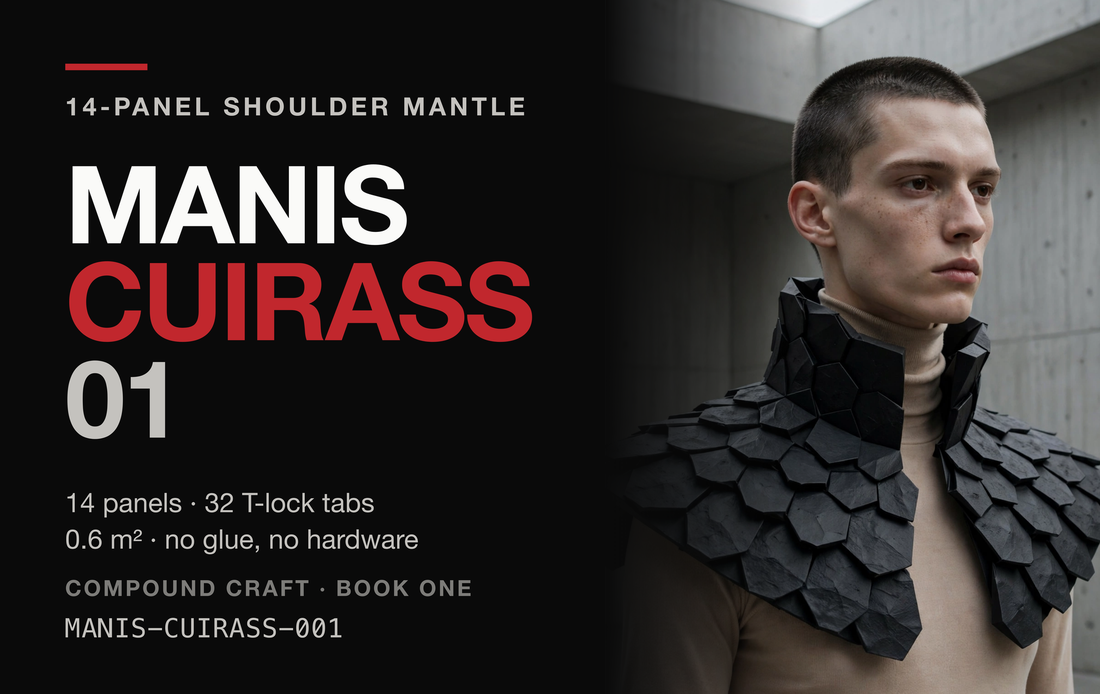 MANIS-CUIRASS-001
Manis Cuirass 01
A 14-panel pangolin-scale shoulder mantle, cut from 2 mm EVA
foam or craft board and locked together with tabs. No glue, no hardware.
Open the card
MANIS-CUIRASS-001
Manis Cuirass 01
A 14-panel pangolin-scale shoulder mantle, cut from 2 mm EVA
foam or craft board and locked together with tabs. No glue, no hardware.
Open the card
- LEAVES BEHIND
- A 1:1 cutting template, and a tab-and-slot solver
- LICENCE
- Design CC BY-NC 4.0
Card 002
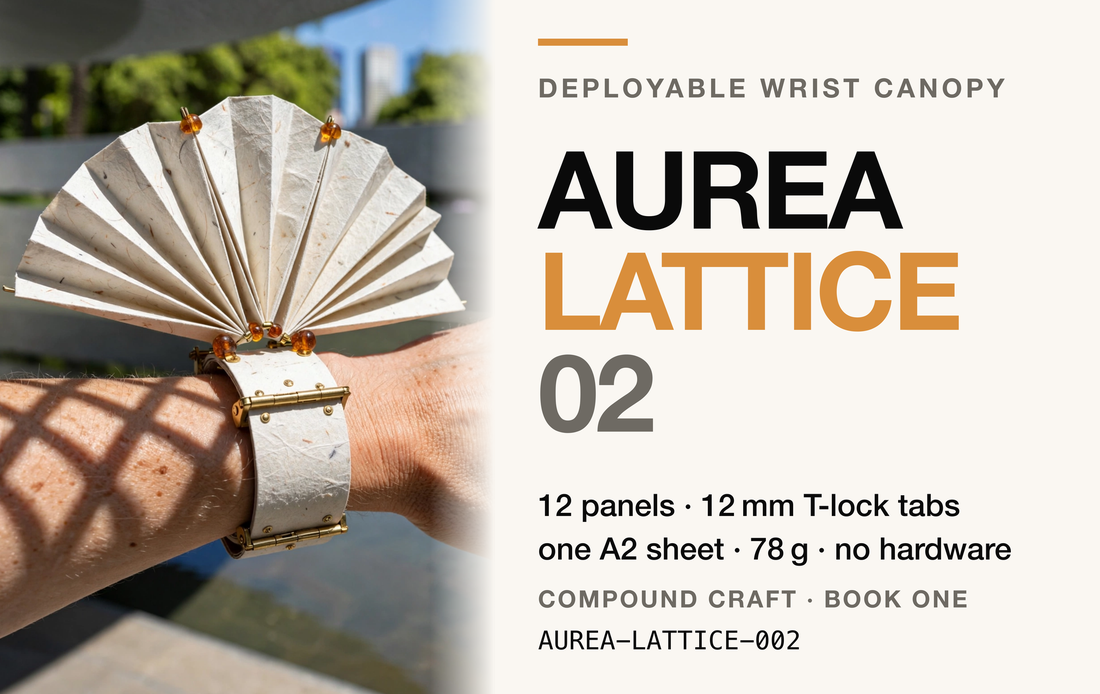 AUREA-LATTICE-002
Aurea Lattice 02
A 12-panel bracer cut from one A2 sheet, 420 × 594 mm,
of washi — layered Japanese paper — or craft board. It wraps the wrist, and its
pleated top opens into a fan that shades your arm. No glue, no hardware.
Open the card
AUREA-LATTICE-002
Aurea Lattice 02
A 12-panel bracer cut from one A2 sheet, 420 × 594 mm,
of washi — layered Japanese paper — or craft board. It wraps the wrist, and its
pleated top opens into a fan that shades your arm. No glue, no hardware.
Open the card
- LEAVES BEHIND
- A layout for the back of a card that fits the code and the numbers beside the drawing, not over it
- LICENCE
- Design CC BY-NC 4.0
Card 003
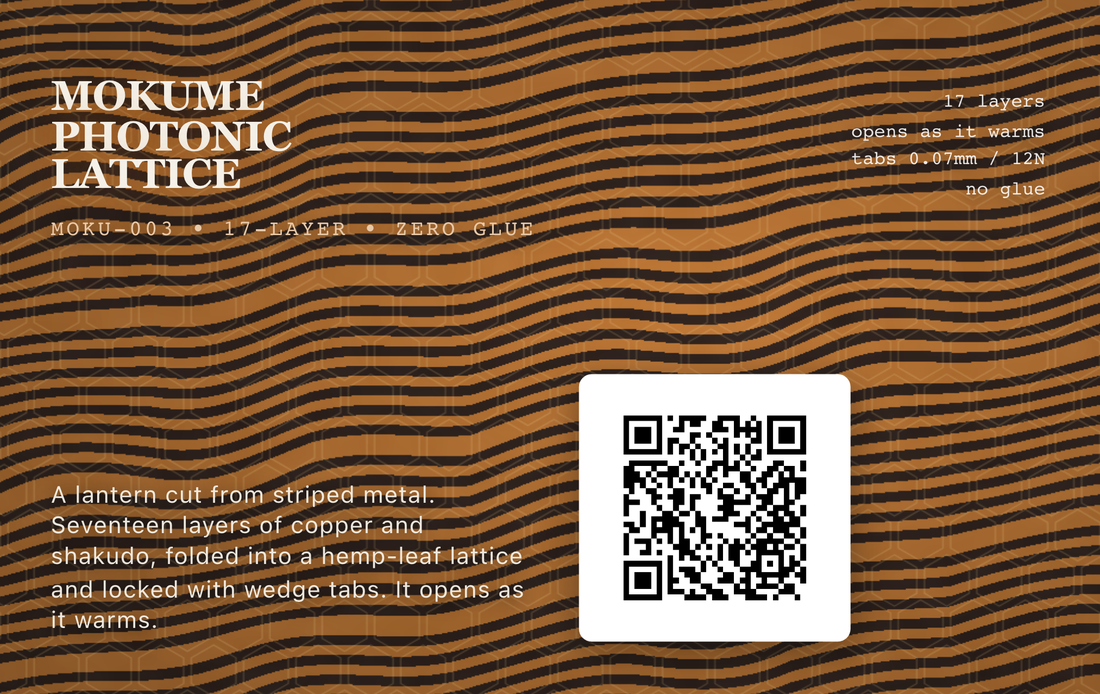 MOKU-003
Mokume Photonic Lattice
A lantern of striped metal — 17 layers of copper and a dark
copper-gold alloy — cut into a hemp-leaf lattice and locked with wedge tabs. No
glue. The lattice is meant to open as it warms, because the two metals expand at
different rates. By how much is unsettled — the card sets out both numbers.
Open the card
MOKU-003
Mokume Photonic Lattice
A lantern of striped metal — 17 layers of copper and a dark
copper-gold alloy — cut into a hemp-leaf lattice and locked with wedge tabs. No
glue. The lattice is meant to open as it warms, because the two metals expand at
different rates. By how much is unsettled — the card sets out both numbers.
Open the card
- LEAVES BEHIND
- A check that measures where every word sits on a printed card, in millimetres from the edge
- LICENCE
- MIT · set by its author, and left that way
Card 004
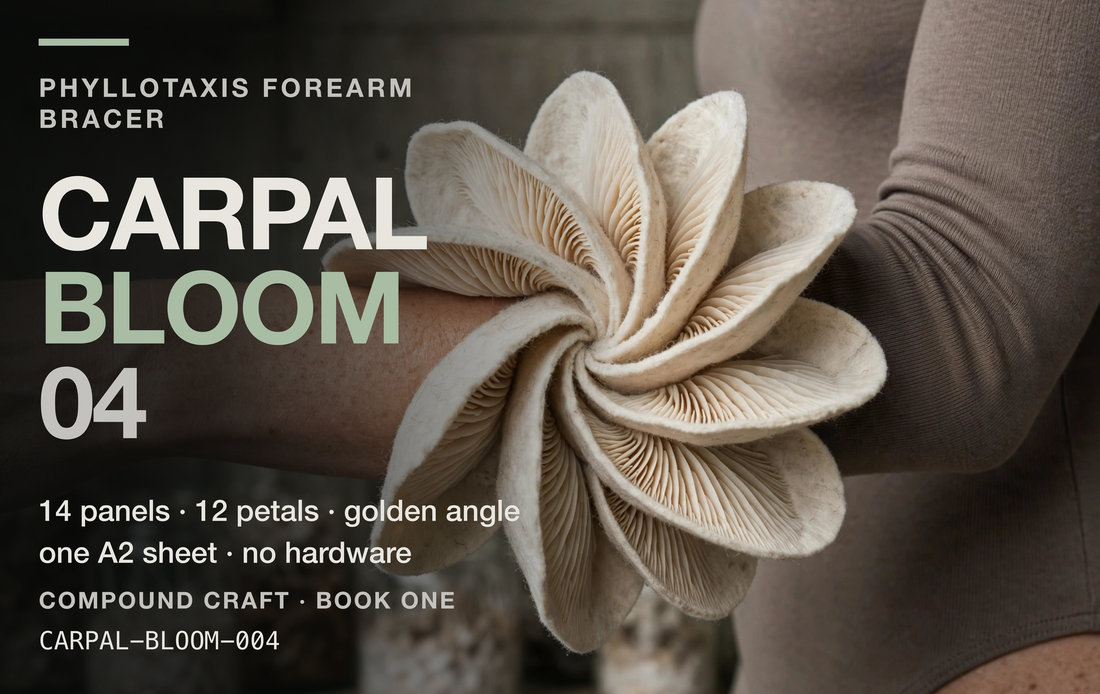 CARPAL-BLOOM-004
Carpal Bloom 04
A forearm guard that lies flat and opens into a fan around the
wrist. Fourteen panels — twelve pointed petals and two cuff bands —
cut from one A2 sheet of card or felt. Each petal is set 137.5° round from
the last, which is the turn a sunflower uses. No glue, no hardware.
Open the card
CARPAL-BLOOM-004
Carpal Bloom 04
A forearm guard that lies flat and opens into a fan around the
wrist. Fourteen panels — twelve pointed petals and two cuff bands —
cut from one A2 sheet of card or felt. Each petal is set 137.5° round from
the last, which is the turn a sunflower uses. No glue, no hardware.
Open the card
- LEAVES BEHIND
- A living-hinge fold that is also the joint, and the golden-angle spacing that makes twelve overlapping panels close flat
- LICENCE
- Design CC BY-NC 4.0
Card 005
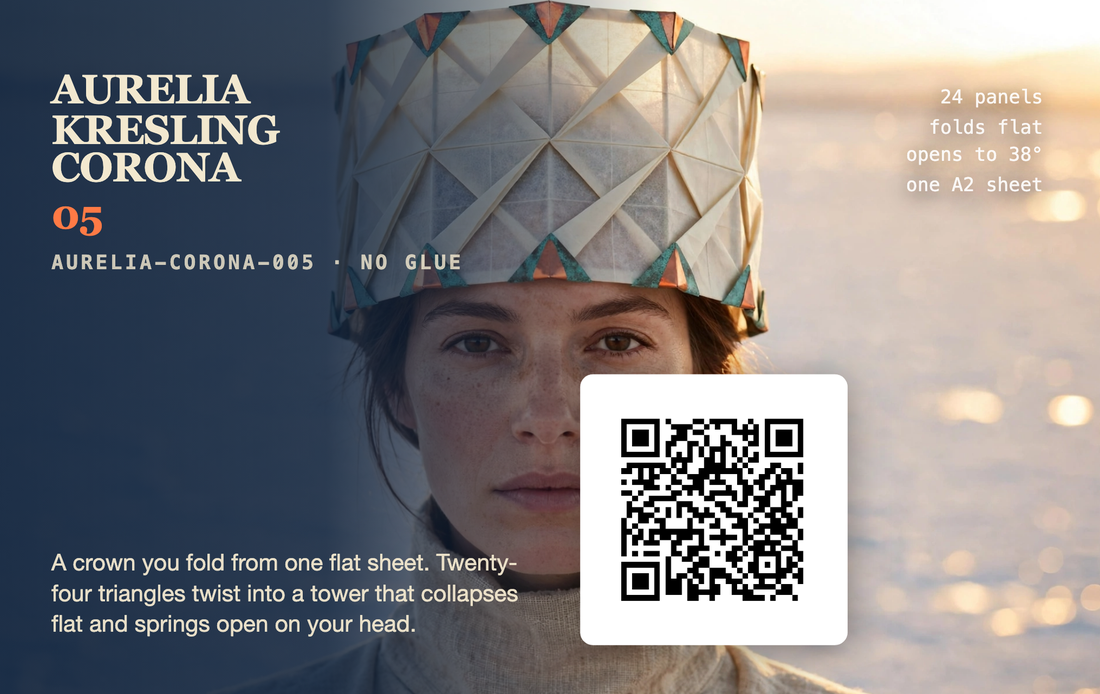 AURELIA-CORONA-005
Aurelia Kresling Corona 05
A crown you fold from one flat sheet. Twenty-four triangles in a
continuous strip twist into a tower that packs flat and springs open on your head.
It uses card 001’s tab and slot, unchanged.
Open the card
AURELIA-CORONA-005
Aurelia Kresling Corona 05
A crown you fold from one flat sheet. Twenty-four triangles in a
continuous strip twist into a tower that packs flat and springs open on your head.
It uses card 001’s tab and slot, unchanged.
Open the card
- LEAVES BEHIND
- The Kresling twist — a tube that collapses and springs back, for any later card that needs one
- LICENCE
- MIT
Card 006
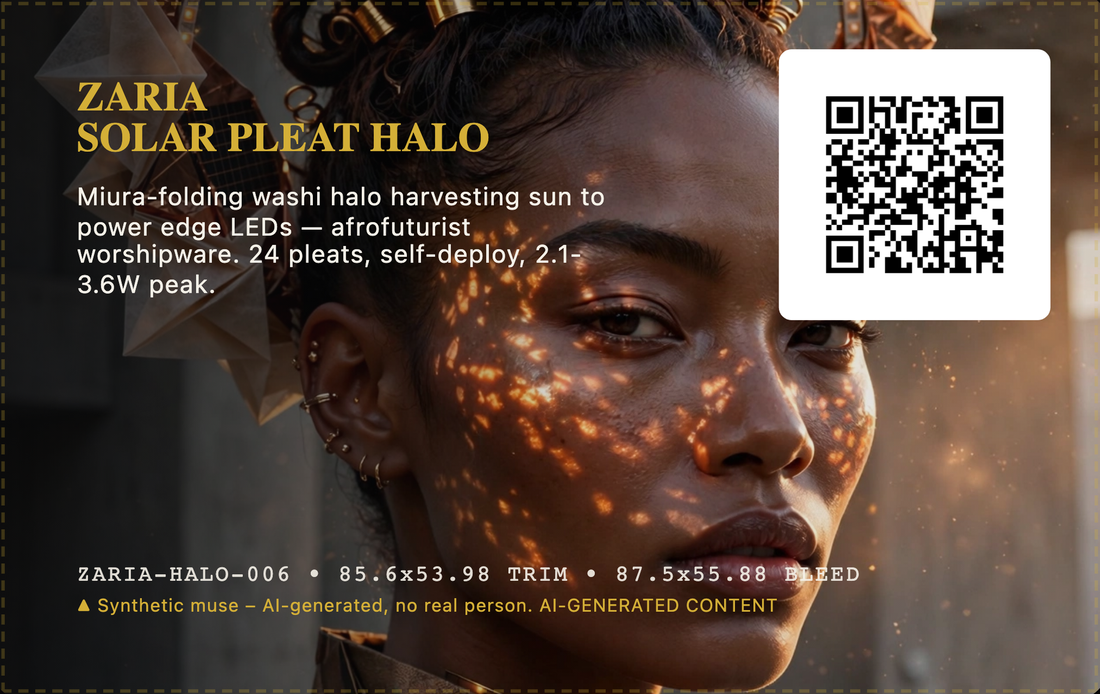 ZARIA-HALO-006
Zaria Solar Bloom Halo 06
A halo folded from washi paper on a Miura fold, with thin solar cells
on its outer pleats and lights at its edge. Pull two corners and the whole ring opens
in one motion — the fold spacecraft use to unpack solar panels.
Open the card
ZARIA-HALO-006
Zaria Solar Bloom Halo 06
A halo folded from washi paper on a Miura fold, with thin solar cells
on its outer pleats and lights at its edge. Pull two corners and the whole ring opens
in one motion — the fold spacecraft use to unpack solar panels.
Open the card
- LEAVES BEHIND
- The one-motion deploy — a surface that packs flat and opens on a single pull
- LICENCE
- MIT
Card 007
 KAZE-KIRI-007
Kaze-Kiri Wind-Cut Collar 07
A collar cut from one flat sheet that snaps open with a twist and
locks with three wedge tabs — no glue and no hardware. It crosses the two folds
the cards before it paid for: one twists, the other packs flat.
Open the card
KAZE-KIRI-007
Kaze-Kiri Wind-Cut Collar 07
A collar cut from one flat sheet that snaps open with a twist and
locks with three wedge tabs — no glue and no hardware. It crosses the two folds
the cards before it paid for: one twists, the other packs flat.
Open the card
- LEAVES BEHIND
- A solver that turns a diameter, a height and a twist into a flat pattern with its tabs already placed
- LICENCE
- MIT
Notes and corrections
Card 001 establishes the pattern the rest of the book inherits.
Card 002 uses card 001's lock unchanged: a 12.0 mm tab in a 12.4 mm slot.
Card 003 was made elsewhere and handed over. Four things had to change before it could be a card here.
Card 004 was built for slot 003 and printed two numbers for itself — 03 in large type over an ID line ending 002, which is card 002’s number. Both read 004 now.
Card 005 arrived numbered 01, from a run that does not include cards 002 and 003. Corrected before anything was printed.
Card 006 is the first in the book that carries electronics. Its power figure is calculated from three assumptions and the card says so.
Card 007 is the first hybrid in the book, and it was the cheapest to make: both halves of it had already been bought by cards 005 and 006.
What is not here
Seven cards. That is the entire book today. Cards numbered 008 and 009 do exist — Rexi’s Vibe Tag and Kelibro, whose back face is GESICA — but they are not in this book and are not missing from it. They share the project’s numbering, not the book’s rule: a card joins the book by leaving a tool behind for the cards after it, and those two — a pet tag and a printed picture — leave none. There is still no list of what is planned, because no plan exists.
Why nothing here is a plan
A page that promises a dozen cards and ships one is a specific, documented failure in this repository, and it is worse here than most places: these pages are opened by a phone that just tapped a physical object, so an index entry that goes nowhere is a promise made by a thing you are holding.
So the rule stands and only the count has changed: a card gets a row when it is real — cut, folded, worn, and behind a chip — and not before. Nothing on this page is a plan.
Which craft next?
This is the useful question and it is genuinely open. Name a craft you would want as a card — the thing itself, or the tool it would need built. What would you want to be handed, already solved?
No account, no email, nothing to sign up for. Just write and tap. It goes into a queue someone works through, not into an inbox.